A rail journey around India, beginning & ending in Mumbai...

A rail journey around India, beginning & ending in Mumbai...

Friday, 3 October 2014

Rail roading to Jaipur...

Checked out of the super friendly New Tokyo Palace hotel--if you should have a couple of days free in Jaisalmer, this is the one I would recommend. Out at the railway tracks, located my reserved carriage & berth ready for the 5.00pm departure of the 'Delhi Express'. Jaisalmer is the "end of the line" in
Jaisalmer  railway station.
more ways than one--up against the Pakistan border and obviously in the rolling stock India railways allocates for this run into the capital from the back woods. The carriage was dirty and teeming with cockroaches: that was first class!--- pity the masses travelling back in unreserved! It soon became obvious when the train rolled, that we were over a bogey with oval wheels. Rocked, rolled & swayed all the way into Jaipur 12 hours later. Also strange, was the fact that the omnipresent on board wallahs who service the hungry crowds with water, sandwiches etc., had all disappeared to let the customers survive best they could. An alternative eating strategy is to hop out on to the platforms of the various halts and buy from the vendors. Problem with this is that sometimes the stops are two minutes, sometimes twenty.....one never knows.
          Tired and a little motion-sick  we steamed into Jaipur Central bang-on schedule at 4.15am---too early to try & check into ones pre-booked hotel, so squat down on the platform with the masses, who call the railway station home in India. Really pitiful to see old ladies cuddling little babies on rock hard (filthy) concrete, platforms. Not to upset the squeamish, can report that there were large nocturnal rats that scurry about, round & over the sleepers. Certainly tried not to doze & kept my eyes skinned, should one of those filthy sewer rodents come too near to me. Another life experience, and I know one that is to be repeated, as I have several middle-of-the-night train station arrivals scheduled in the next few weeks.
                       Travelling on trains in India does force the European traveller up- close and personal with his Commonwealth cousins---Indian people, so nice, but oh so keen to interrogate with a barrage of really personal questions—how old are you, how old is your wife (!!), how much money do you make, what is your SON’s profession—daughters are not seen as so important, etc etc. Generally, my Indian fellow compartment travelling mates cannot understand why an older man would choose to leave his family, to globe-trot for three months. My explanation that I had never visited India & so why not, never really seems to satisfy them.
                Funny story: Ate my evening meal last night in Jaisalmer Fortress, on the patio
Beer from a tea pot.....
of one of the many restaurants. A very hot evening, so I requested my cold 'Kingfisher' best Indian beer. The lady serving (unusual-always seems to be male servers) explained quite casually that they could only serve beer out of a teapot! She was quite abrupt with me when I queried the reason ---Rajisthan English is not always the easiest to decipher. Apparently the restaurant was situated between two temples and she was anxious not to disturb the spirits by displaying beer bottles on her tables. Bottom line; the beer tasted just great on a very hot night served from a tea pot!.

Tuesday, 30 September 2014

La vie en rose in Jaisalmer...

                  Awakening at a relaxing 8.30 am to the mooing of a couple of cows in the alley at the rear of the hotel. Not complaining, but my beauty sleep had been disturbed earlier, by the 6 o’clock early call to prayers, bellowed out by the loudspeakers of the nearby mosque. Just call it culturally enriching!
Now, that is how to carry a sewing machine....
              I am staying at hotel that rejoices in the name ‘The New Tokyo Palace’' located in central Jaisalmer. According to the front desk wallah, a Japanese tourist so enjoyed his visit to these parts, that he decided to return & set up shop here. Apparently, he also owns a restaurant in Tokyo and directs a stream of Japanese tourists ---not seen any myself---but am assured they will be arriving soon when the cooler  weather takes hold. Actually. seen very few identifiable tourists so far on my trip—probably a lot more domestic & overseas Indian tourists, but of course, I cannot easily identify them from the masses.
          My wanderings around the town tend to be limited to 2-3 hours a day, as the mid-day sun is brutal with a litre of pilled water, consumed for every kilometre forward—how is that for motive efficiency.
          A tourist town with very few tourists, the street hustlers & promoters of Jaisalmer are very aggressive---the top attractions are a trip to the ‘real’ desert and a ride on a camel up a major sand dune. Not worth the effort/money according to several tourists (Australian) with whom I have chatted. Most of the half-day trip, is in fact, side excursions to villages where visitors are pitched to buy tourist nic-nacs of a dubious quality. The calls from local street vendors of  “where you from?” ring in ones ears consistently. When I say (to those who
need to know), I sense that I am being set up for a special (Canada) high price, or perhaps I am just cynical in my senior years!

            Any way, it’s lots of fun and being privileged to visit these exotic locales, one has to realise that every day life for the masses here must be really tough compared to the molly-coddled existence that so many enjoy in the West & for whom an internet outage of 5 minutes, is a life crisis!

Monday, 29 September 2014

Jaisalmer--India's wild west!...

           Arose at 3.30am ready to find my driver to take me to Jodhpur railway station for the early train to . Getting into the groove of the Indian railway system thing. I have bumped into several other tourists and while exchanging tourist chat discovered that in frustration have abandoned the whole India rail travel project due to the bureaucratic complexity of ticket purchase & seat reservation, opting for air or bus transport between cities.
Sleeping  rough......
Jaisalmer
          At 4.15am the large concourse in front of the station and the platforms were packed with masses of  men women & children camped out. They did not seem to have luggage with them ---were they the homeless, or just folks trying to dodge a hotel overnight expense—the former, I judge.
        Jaisalmer is located at the western extremity of my routing, not too far from the Pakistan border, reflected in the fact that the town has significant numbers of armed soldiers lounging about and the frequent screech of military jets overhead. This region can be labelled as-semi desert and as the train travelled west there was a marked decrease in vegetation & an increase in the aridity of the land.
            Jaisalmer could be labelled as ‘exotic’--- it is dominated by a 1000 year old medieval fortress. Unlike the fortress in Jodhpur that is a relic/museum, the one in Jaisalmer is a living massive tourist shop,
restaurant and hotel plaza with approx. 4000 people living within the walls of the edifice. Historically, this city
has earned its keep as a key station on the road from central Asia through which the camel traders had to pass. In 1948 with independence and the closing of the border with Pakistan, its fortunes went into decline. Jaisalmer’s important strategic location, resulting in the presence of the Indian military, combined with a booming tourist business, has meant a resurgence in prosperity.
              Viewing the landscape from atop the heights of the ancient fortress, one can see hundreds of power generating windmills reflecting the development of modern forward looking India. 
It's tough work, but someone has to test the beds.......

Sunday, 28 September 2014

Of Maharaja's and rickshaw wallahs....

                 The day began at 3.15am to be exact, when I received a dousing in ice cold water from a recalcitrant air- con unit  positioned above my head and which suddenly decided to go into reverse gear and spew its contents over me! Some bedroom re-organisation and no more problem.
The  last Maharaja's Palace......
                   First job today was to round up a reliable auto-rickshaw driver to carry me at 4am tomorrow to  Jodhpur rail station about 3kms from Wem's Guest house. Now the optimum word here is reliable. Offering him 10 times the going rate of $1 for his cooperation and hoping that this is inducement enough to ensure his services. Probably more than he regularly earns for a whole days work.
                   Rickshaw issue (hopefully) settled and and on to see the former Maharajah's local digs. His Excellency, billed at the time of his death in 1947, as one of the 5 richest men in the world. His auto fleets, preserved at his palace includes 10 Rolls Royces. Known as Umaid Bhawan Palace, it was designed by a British architect and took 3000 labourers 15 years to construct, commencing in 1929. This was viewed apparently as a social project for his people, so as to provide employment during the world economic depression. His order, placed in the UK during 1942 for a ship load of custom designed Art Deco furniture, was apparently lost through German U-boat action en route. My thought on reading these interesting facts was whether Winston Churchill was aware that whole ships were being used to ship such trivia in the midst of a world crisis.
                         Umaid Palace was constructed from local marble and with a total absence of concrete. Each stone individually cut to interlock with the next stone laid. Apparently, some times the cut blocks were so heavy that they could not be man- handled into precise position by the labourers. The solution was to lower into approximate location by the cranes onto blocks of ice and be slipped to exact locking position as the ice melted.
                        Point of interest: From the roof-top terrace of my guest house, I watched construction on an
I watched them do this dawn till dusk.
adjoining building. Almost total absence of any on-site mechanical lifting devices---everything hauled up using human muscle power. Bowls of prepared concrete hauled up the stairways and dumped by female labourers carrying loads balanced on their heads. Not pleasant work in 38C temperatures.  Last week India placed a satellite into orbit around Mars. Makes one ponder!!

Saturday, 27 September 2014

Above Jodhur at Meyrangar Fortress

         Gently coaxed myself forward through the heritage entry arch of Wem's guest house at 10.30am . My target today is the impressive Meyrangarh fortress built on a 400 foot 'rock mountain" that rears up and dominates Jodhpur. Realising that in this heat it is not advisable toset oneself up for an overly physical regime of sightseeing.  "Bravely' (stupidly?) I committed myself to walk up to the fort entrance via a very narrow, steep and twisty lane which quickly degenerated into long flights of stairs. Paid my $6 entrance fee--expensive for India, my camera fee, my social donation fee and I was free to set myself  loose on the several museums in the fort. Access to the fort is sheer and impregnable and is hailed as one of the most magnificent in India. The fort was constructed in two phases, early 1600's and the early 1800's in response to invaders from the North.After salving my conscience & scanning the exhibits, I climbed up to the battlements for a photo session. The viewing points offered magnificent vistas across the city ---a city that is also famous as being the "Blue City" of India. Apparently, the Brahman caste, the highest caste, traditionally painted their houses all blue in order that they could be easily identified. In these more enlightened times, others of lower castes, caught onto a good idea, so that there are now many buildings painted blue across the city.

Photos duly taken, I treated myself to the auto rickshaw ride back down to street market area around the central clock tower, in the hope of rounding up a cool drink, or three, and acquainting myself with the maze of narrow lanes & passages that constitute the main commercial area.
She's being fattened for Eid. (the goat!).
         Comment. The currency system of India is denominated in rupees. .Approx. 60 to the $US. Very few coins in the system. Paper notes as low as 5 rupees.(10 cents).Small notes are much sought after to make change. It is a constant battle between buyer and seller to manoeuvre the other party to give up his small notes. Offer a rickshaw driver a 100R note for a 70R ride and he will feign that he has no change. ---shafted again! Ditto, transactions in the market and with the street vendors.

Interesting fact: Those of you that ride horses will know about jodphurs,high leather boots that are used to protect the riders legs. The name of these high boots hails from Imperial times in this city of Jodhpur when British officers carried the name back to the UK. Likewise,  the  words gymkana, (a horse show),  bungalow & veranda also derive from that same colonial period, when words were imported back to the UK by returning soldiers.
Picture on right. I mistakenly thought this beautiful goat living in the house was the family pet. Today, I discovered that she is being fattened up for the upcoming Eid festival. Poor goat--she is so friendly & tame.

Friday, 26 September 2014

Riding the rails to Rajasthan.....

           A second leg of the rail journey accomplished--the stage from Ahmadabad northwards to Jodhpur  (pop. 846,000) in Rajasthan. Departed Ahmadabad at 11.20am, arrived Jodhpur at 8.15pm., exactly on time. I did note that India railways operate a single track system in this part of its network--that is, with passing points of twin track at specific points, to permit trains moving in opposite directions, to pass. Should the oncoming train be late, of course delays are incurred by both trains, so as to facilitate a safe passing procedure.
All ready for a siesta....
          This second train travel leg was more relaxed for me and I was able to take more time observing my surroundings. Train travel, like Indian society is highly stratified, with different social groups travelling in different classes of carriage on the train. At a cost to me of about $6 per day unlimited travel, I was able to travel 'top class'. with typically white collar professional types in predominance. My compartment companions hastened to inform me that Dad was a judge and 28 year old son a newly minted lawyer. My AC 2  class has seating for 6 persons---that is three seats lower level and three above, all extended out into full length beds. Bed coverings all supplied at no charge--freshly laundered pillow case sheets and blankets. Yes, blankets, as the compartment in AC2 can get cold---ridiculous when its 36C outside.
                     Friendly to the extreme, I am sure by the end of the journey that I will have a lifetimes supply of  'new best friends'. My fellow passengers are very curious and quickly launch into a barrage of personal questions like--how old is your wife, how much do you earn, what is you e-mail address?? Fun at first, the questioning can tend to become a little intrusive. Since I have arrived in India, 10 days ago, I have only seen perhaps a half dozen westerners--travellers with European features have real curiosity value and invite stares and requests for a 'selfie'. This surprised me as I was expecting places --hotels, train stations, to be much more cosmopolitan.
View from the vestibule....
                  Exploring beyond my compartment, I spent considerable time between stations, standing in the small entry vestibules of the door entry points, located at either ends of  the carriages (referred to as rakes) in India). Indians do not have the same preoccupation with safety as in other places, and so the doors are left wide open and passengers are free to hang out as the train charges along,  frequently traversing high bridges and ravines. Makes for great opportunities for photo opportunities along the exterior of the train as it rounds the curves. Nowadays, with overhead electrification, riding on the roof, in the cheap seats, is no longer a (exhilarating) rail travel option. Anyway,  the vestibule is a  place to meet the locals and helps to while away the long hours in motion.              
                   
A weary wallah....
Food service to passengers on the train is fast and furious with non-stop streams of 'wallahs' offering every sort of food item one could want. Especially enjoy the chai (tea Indian style)  hot --as in temperature, and sweet, made with condensed milk at 20 cents per cup.
                   Over all Indian rail travel, despite aged & deteriorated equipment, is a pleasant surprise, comfortable, relaxing and very sociable.

Thursday, 25 September 2014

Traffic mayhem....

                Traffic & roads in India--pure chaos & confusion. First of all the drivers--I am not sure if there is any requirement to take/pass a driving test in India to learn & apply any user code, and if there is, it has been 100% rejected. The streets are jammed with vehicles from large trucks, motorcycles, school buses and myriads of angry three wheel green & yellow auto rickshaws that buzz about emitting clouds of blue smoke. Human muscle powered vehicles, bicycles, handcarts, seem to have largely disappeared from the traffic scene. Common sense indicates that complete grid-lock should prevail, where nothing moves, but miracle of miracles, everyone keeps moving along with non-stop assistance from every driver in terms of continuous heavy non-stop application of horns.
                 Traffic users drive absolutely where ever they wish---wrong direction up a one-way street--no problem. Wrong side of a dual carriage way system--just go for it. Over the sidewalk--don't worry the pedestrians will jump out of the way! Add to the road madness, the wandering cows and you have the picture.
              The idea is that every one knows the de facto road rules. Keep going until you get blocked and yield when someone else blocks you. It's a game of inches. And its not just male driver aggression, the Indian lady scooter riders are any ones match in the hard ball game of traffic survival.
Busy streets...
               An attempt has been made to install traffic light sanity at some major intersections so as to control traffic flows. The red lights are totally ignored, as vehicles from all directions surge forward to assert their priority right of way. Traffic police loiter at key intersection, totally ignoring the mayhem right in front of them--I am told that employment as a traffic cop is a guaranteed job for life-- so why work when the opportunities for bribes are so plentiful? Already, during just this first week in India I have perhaps ridden 20+ auto rickshaws and have to report that I've not seem a single collision, or scrape, occurring as we have charged along, your humble scribe hanging on for dear life. Drivers actually smile at each other and and share banter as they inch forward. Yes, Indian city traffic chaos shouldn't work---but it does!


Wednesday, 24 September 2014

Gandhi Ashram by the river...

              The first place on my list to visit in Ahmenabad had to be the riverside Gandhi (Sabarmati) Ashram with whom it is synonymous. Richard Attenborough's epic movie "Gandhi", made the Ashram seem quite familiar to this visitor:  Just last week, the President of China was in India for the first time for decades
Gandhi's Ashram 1917-30.
and his itinerary included the Gandhi Ashram. Gandhi based himself at the Ashram during the period 1917-1930. It's location, it is said, is midway between the city jail and the main cemetery --- he felt that he would end up in one or the other sooner or later! Luckily, I chose a quiet business day for my visit and was able to enjoy the artifacts and rooms in  relative peace. Particularly poignant was his spinning wheel and pillow  in position on the floor and against the wall, where he worked planning his strategies that eventually led to the  achievement of Indian independence. Very clear was the Christ-like reverence that ordinary Indians hold Gandhi's memory. My auto rickshaw drivers both directions of the trip, tried to recount (in their very broken English), parables from Gandhi's life. Recent memories of having seen Richard
Musical interlude at the Ashram
authenticity, on site. My visit was made most pleasant and worthwhile photographically, by a group of beautiful 10-15 year girls attired in colourful saris who performed graceful and delicate dance formation manoeuvres to traditional music.Totally worth the 50 cent admission fee!

              It seems a tradition for me, that when I embark on my long journeys, I contract a rotten heavy chest cold & cough. In this case, perhaps I can put it down to the continual switching from icy cold air- conditioned hotel  rooms and the very hot, humid weather outside.
                  My second port of call, and billed by Lonely Planet as a refuge from the bedlam of the streets, was Kankaria Lake...a large lake originally built in 1450, and recently 'dandified' to offer a wide concrete walk with dozens of food locations offering all kinds of temptations. Again, not to busy today (midweek). Of note were the young couples, obviously demurely enjoying time together, away from prying families, in a conservative society where male/female relationships are highly structured.
              Noticed that there are a lot more holy cows wandering around Ahmedabad than there were in Mumbai---also, in the smaller city the cows are free to wander as they wish, unlike having to be tethered as in Mumbai. Observed several occasions complete traffic gridlock as several cows chose to stand motionless, effectively closing the street, despite being honked at by a thousand horns.
Much more to say about roads and driving a la India in up-coming posts.
         

Tuesday, 23 September 2014

India train travel baptism....

         Now my real journey in India commences.
Few seats--use the floor....
My train (#12480 to be exact), from Mumbai’s creaky  Bandra Terminus  was scheduled for a 13.15 departure. The train, powered from overhead electric wires, rolled into Bandra exactly one hour earlier to discharge its arriving passengers and permit grooming operations for the out bound crowd.. Comfortably ensconced on soft bales of clothing stacked for collection in piles on the platform, I watched with interest, the comings and goings -- all the teary goodbyes from Indian families on the move.
          The task to locate the carriage (or ‘rake’) as they are called in India, I can see is going to be non-ending until I understand the principles they use. My carriage & seat location, per the computerised ticket control was HA1 and people kept telling me that HA1(sounds like an infectious disease!) would roll in exactly opposite a predetermined position on the platform—problem was no-one could exactly explain where precisely the predetermined position was. Solution achieved this time, when a porter wallah eventually guided me to the correct platform location. Sure enough, HA1was right there where it should be, complete with a
Bandra--Mumbai's second main station
computerised passenger list pasted to the entrance door way informing all of my name, age, gender, passport number etc. Finding ones seat may seem a trifling issue, but Indian trains are very long, very crowded and do not have connecting passageways between carriages for the lower classes and the posh types who travel in air-con first and second. To board the train in the wrong position, could mean that one is stuck on wooden seats in the wrong class, even standing, for many hours.
                     Rail station platforms in India are well supplied with booths selling every type of food for the journey and throughout the 9 hours to my destination in Ahmedabad, we had a constant stream of wallahs passing down the train offering everything from hot tea, sandwiches, cookies, nuts, to ice creams. Each arrival of a fresh offering accompanied with a singy-song wallah repetition of the item offered.
              My train arrived in Ahmenabad exactly on time at 21.15 and after a spirited negotiation of the auto rickshaw fare, arrived at my Hotel Accolade 8 kms away across the large river that segments the city.

Monday, 22 September 2014

Getting to know the back streets of Mumbai....

               Leisurely start to the day---8.30am breakfast in bed!! No point in rushing---let the early morning rush hour volume ease off a little. My target today--thank you 'Lonely Planet' was the Kotachiwadi (wadi meaning hamlet).This is a small Christian enclave, surrounded by  predominant Hindi and Muslim neighbour-hoods. Noted several Christian shrines and St. Teresa's church--notable for its fresh paint and general heir of high maintenance in contrast to much of Mumbai. Vehicular traffic is not allowed in Kotachiwadi's narrow streets of formerly elegant, now relatively dilapidated wooden two storey homes, although noisy motor scooters seem to use the area as a shortcut.
                 Temperatures are higher today and the sun is quite fierce, so the pace of sight seeing is slow. It seems that one consumes bottled water by the litre without need of conveniences.


UNESCO rated ---Mumbai 's ornate main railway station.
              Today my mind has been moving into rail transportation mode, as tomorrow I officially commence my long rail journey around India.---Mumbai to Ahmadabad, first leg---about 8 hours travel time. Not totally sure of the standard of food service offered by India Railways, I bought packets of dry biscuits. apples and other fruit. I also took a recce to the main Mumbai rail station--Victoria Terminus. The outside of the building is 1860's colonial high ornate, looks like a European cathedral and is a listed UNESCO monument. I watched the trains roll into position and board their long distance passengers. As I had been pre-advised, the trains seem to be hundreds of metres long and the trick is to locate the correct carriage andspecific berth therein. Passenger waggons all look as if they were built in the 50's and put in 5 million miles plus! The names, gender & ages of all passengers are listed on computer run-offs pasted to the relevant carriages, along with a personal code (known as a PNR) for all individual passengers. Obviously, concern for privacy regulations has not yet overtaken Indian Railways. All quite intimidating, but I am sure that I shall master the complexities of Indian rail travel in due course.

Sunday, 21 September 2014

Ferry to Elephanta Island...

                 Sunday in the city and early riser that I am, quickly sensed that at 6.30am the noise and bedlam level of the traffic was somewhat less than usual. Even the taxi drivers deserve one day a week to be tardy. Breakfast (omelet,  three slices of toast with coffee), served on a tray delivered to my hotel room.quickly
consumed,  I grabbed a taxi to the Archway to India ferry boat location..
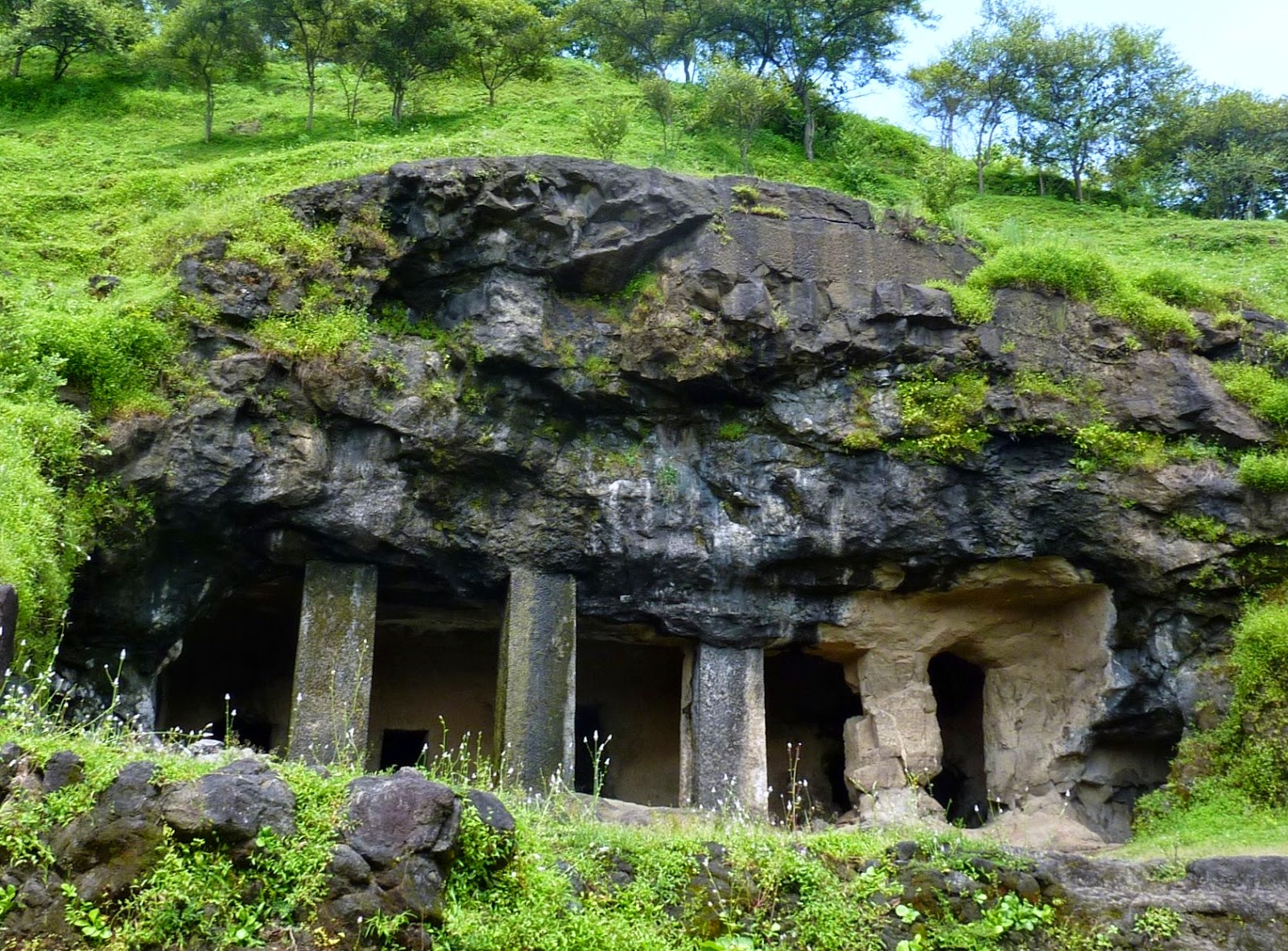
                 Skies clear and sea calm, it took about an hour for our elderly ferry to cover the 9 kms out to Elephanta Island. So called, as an early Portuguese explorer felt the Island resembled a pachyderm lying on its side. Our ferry passed close to Indian Navy installations and oil tanker discharge points. Upon arrival & temperatures rising, I followed my fellow tourists along a half kilometre causeway to the island proper, where upto the  seven caves and the tacky tourist stores commence, with the usual strong-arm selling techniques applied aggressively to this mixture of locals plus Chinese, US and European tourists.The tariff for admission to the UNESCO recognised cave site was 50 cents Indian, ten times more, $5.00, for foreign tourists. Apparently this10 to 1 entry price rule is the norm in India at cultural & religious sites. Fair or not, I won't judge. Witnessed my first overt act of corruption at the ticket booth. The rule is to hand back to the visitor part of the cancelled ticket--nothing was handed to me, so I asked--the visitor portion from another ticket was torn from another already cancelled ticket, so presumable my ticket could be returned at the end of the shift, as unsold and my $5 pocketed. Not bad if you can do this a 100 times a shift!
Polite monkeys.....
the steps
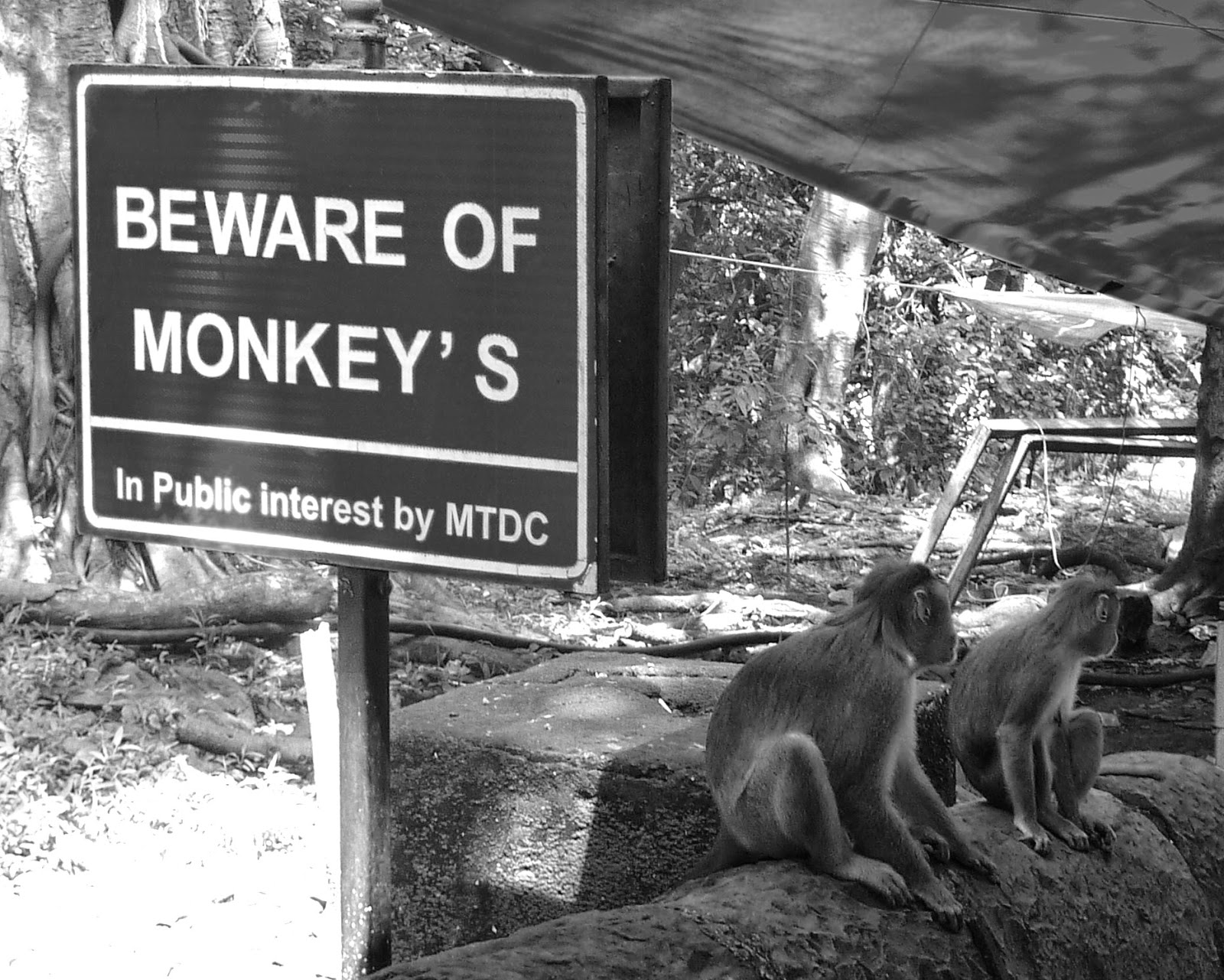
                     I duly climbed the steps and entered the caves duly photographing the rock carvings. my Google "Elephanta Island" for the full historical blurb. Warning everywhere alerted about the poorly behaved monkeys that inhabit the island. All that I saw were the very epitome of politeness to us tourists.               .
One of seven caves.
readers will quickly gather that I am not strong on the details of ancient ruins--if interested to learn more, I suggest to my readers that they
              Early to arrive, and after tea and a sandwich, boarded an early ferry back to the mainland. Just as well, as the lineups that I passed for outward tourists were now extensive. Never must I forget that this is a country of nearly a billion souls. Back to the hotel for a relaxing shower, some laundry and a siesta---not in that order.

Saturday, 20 September 2014

Human powered washing machine.....

             An early start to the day brought me to a miracle of organization.--- the Mahalaxmi Dhobi Ghat. Chances are that if you have had your washing contracted out in Mumbai, as many tens of thousand do in the city, that it has been picked up & transported to this dhobi ghat (meaning--washing place).
Washing time at the Mahalaxami dohbi ghat

                 Established for over 140 years, this human powered laundry machine is a hive of activity with clothes being rubbed, scrubbed and beaten clean.in over1000 troughs. I am informed that each and every clothes item is retrieved from the process, spun dry and returned neatly packaged to its correct owner.
                 Today is Mumbai hotel change day for me today---third since arriving and hopefully situated in a worthwhile area on the east side of the peninsula., so just past noon  I piled into another taxi and proceeded to the Elphinstone. Located in a rather non-descript area right next to an Indian military base that I mistook for a prison, with its high walls and barbed wire. Rather taken back at the slummy external appearance,
Elphinstone Hotel, Mumbai
crowds of men with apparently not much to do, my accommodation was accessed up a couple of flights of dirty & dark stairs---not as depicted on the internet booking site. However, things improved with the reception area and actual rooms are bright, clean and well appointed.

Friday, 19 September 2014

Let tourism commence...

It's beginning to click now---that is, my brain is gradually starting to catch up with my legs--jet lag is subsiding. Determined, despite threatening skies to do some serious Mumbai site-seeing this morning. Feeling particularly optimistic about the world after having seen the results of the strong 'No' vote victory in Scotland. Availed myself of one of the literally thousands of cruising taxi cabs in this part of the city & for just 100R/$2 I am transported, clutching my trusty 2 inch thick Lonely Planet guide, to the iconic city landmark---known appropriately as "Gateway to India.. Built  to mark the King George V/Queen Mary tour of India in 1922 and  to celebrate everything imperial, it also marked the monument through which the departing British army marched to awaiting ships, just 26 years later, as India gained her independance. Like so much in this city, the  Gateway arch seems to be in semi poor repair,
Selfie of geeky tourist and pigeons at the 'Gateway to India'.
crumbling under layers of mould and moss. I have been surprised to observe so very little new construction activity across the whole city. The reality does not seem to match up to all the pre-visit internet pictures and boosterish material that I consumed. Mumbai seems tired, worn-out and in need of massive repair and renovation. The preponderance of pretentious and dated colonial edifices seems to me, to only add to the feeling that Asia's recent explosive changes have by-passed this metropolis.
                     Not feeling very creative in the 35 degree heat & torpid humidity, I was glad to follow the suggested Lonely Planet walking tour suggestions. At least it kept me from becoming immediately disorientated in the maze of crowded side streets off the major avenues. Upon return to the Gateway starting point and time for lunch time sustenance, I hit the crowded adjacent narrow streets to meet the holy cows, tiffin delivery wallahs and all the sites and sounds of street life. With some trepidation,
Holy cows roped to a fence.....
I dived into street food action. Very tasty actually and amused my fellow diners by beseeching the "chef" to go lightly with the hot spicy sauce. The food served up piping hot on squares of newspaper,  is consumed with the fingers. A bucket of murky water is offered to rinse-off when completed. Just hoping that the high cooking temperatures and volume of the fast cooking service has effectively killed off any potential bacteria.
       Later: about 6.00pm.head out to find some dinner. Have decided to follow the guide book's advice and make my way to the Crawford Market area. A web of streets, a slow 15 min. cab ride from my digs at the Bentley Hotel on west side Marine Drive. Out of the cab and into sheer bedlam. A full head splitting 5000 decibels noisier than the usual cacophony that seems to be India. Some kind of religious street festival, complete with loud drums and dancing, whirling youths---no girls! All involved seemed to be building themselves up into somekind of
Crawford night market.
estatic, trance-like spiritual semi oblivion. Crowds of shoppers, holy cows, stray dogs & cats seemed to ignore them. An hour of this intensity and I was almost exhausted, but not before finding a sandwich stall offering a tasty hot meal for less than $1 washed down with a couple of cans of sweetened milk plus rice seeds added.
      By 8.30, back to my hotel room and tranquility, cold shower and some laundry work.

Thursday, 18 September 2014

Learning the ropes....

                  Struggling with my jet lag the main task today was limited to relocating from my first night Mumbai airport area hotel, to the second of three hotels down at the south of the peninsula on so called 'ritzy' Marine Drive opposite the ocean. My illusions that this would be a simple 20 minute drive in an auto-rickshaw were soon dashed. Through chaotic, jammed and ear splittingly noisy, pot holed streets we struggled for 45 minutes at walking pace, or not much more, to a connecting railway station. Long lines to buy my 20 cent ticket and a fight to actually board the train after having determined with some difficulty the correct platform.. Not easy when half the passengers are hanging out of windows and doors. Despite the sardine like conditions and choking heat, everyone seems friendly, helpful & good natured about it all. Lots of help is offered if one enquires as to travel directions platform  number, entrance location for example. Travel congestion, crowds  noise and heat seems to be the facts of life that everyone seems to accept quite stoically here in . It remains to be seen if other cities on my itinerary function similarly. Anyway, even if my 20 minute journey did take 2 1/2 hours, it was a gentle baptism into the Indian rail travel challenges that I will surely confront in the next 90 days.
View from the co-pilots seat...

                       Somewhat surprised that Mumbai is a lot more run down than I had imagined. It was my expectation that the recent string of years of strong economic growth would have 'lifted all boats' so that the general appearance of property and infrastructure would appear to be be in better condition and appearance. I look forward to discussing this with educated  business type Indians that I may meet on trains  etc.
The start of a heavy two hour downpour...
     Weather today: a hot & humid 30C, overcast, with a major monsoonal down pour that lasted about 2 hours between 4 & 6pm.--lucky to have ducked that one, as it was my jet- lag recuperation siesta time!  

First full day in Mumbai........

17 September.

          Within just a couple of hours of completing the second leg of the long Toronto to Mumbai route  it is 5.00 o’clock, & not sure if that is morning or evening,! Flight #1 to Brussels on Indian owned Jet Airways was packed solid and although I drew a central isle “land-locked” seat was lucky in having an interesting young man as my travel companion,  yet another non-practising lawyer, now gainfully employed installing high end kitchen furniture and on his way to a Hanover trade show. Never realised before that this is yet another sector that German manufacturers dominate across most of the world.
Enroute at 35,000ft over Saudi Arabia...
              Flight #2 from Brussels again necessitated the now mandatory slow-moving 45 minute line-ups to clear security. As Brussels is the European hub for Jet Airways, much of my airport pod consisted of Indian travellers ---- fascinating to watch the portly & sometimes out-raged sari clad grannies, being patted down for whatever. Uneventful flight, with only about a 50% load factor. Watching the route map unfold on the plane’s monitor system, I noted that our route took us well south of the Ukraine.
         Presented with Indian Customs forms that indicate that one can only import 10,000 rupees ($200),whereas I am carrying 40,000R. Don’t intend to declare the illegal excess and risk seizure--- will stuff the excess down a sock and hope for the best!.

18 September 2014.
              Happy to report that I am not residing tonight in money smugglers prison. Anti climactically, I breezed through the Mumbai airport immigration process with nary a query directed at me. Beautiful customs hall with lots of seated sleepy looking security people watching as the hordes passed by. Eventually I located
Sleeping dogs everywhere....
the auto-rickshaw (also known as tuk tuks in Thailand) line obscurely located in parking garage level 6B. Haggled with drivers #1 & 2 in the queue and settled on driver #3 at half the original asking price. Challenge was that he was walled in –no problemo in Mumbai---he called over several of his driver buddies and they lifted the vehicle wholesale and re-located it out on the road way proper!

                 With some difficulty, we located in a maze of pot hole filled, pitch black streets the target Hotel Royal Park. Clean room with efficient air-con. No toilet paper or soap---brought my own anyway—too late (midnight plus) to chase around with the wallahs at the reception desk. At $72 this is the most expensive hotel I shall be staying in. I pre-booked and paid extra for a (near) airport location --- strange cities and long rides in darkened streets are stressful after 20 hour flights.

Thursday, 7 August 2014

Final preparations being made....

            My upcoming journey around India is in the phase where it is consuming quite a lot of spare time. No worry: I view it as an investment in the avoidance of predictable problems including much 'down time' (as in missed connections, hotel room searching) en-route. Mr. Murphy is out there somewhere---even in India! Travel mandatories are now complete: visa obtained, along with the three trip visit to the local health clinic for shots. Call me a planning freak---but I do not like problems to arise when travelling ---adverse situations that can be obviated with a modicum of planning forethought. Talked to key people and read alot. One of the most complicated areas to pre-arrange on this journey around India has been the logistics of travel by train. Through the helpful folks at SD Enterprises, Wembley, UK, my nearest official India Railways ticket agents, a 90 day rail pass has been purchased, and at no extra cost, the seat reservation process has been completed at least for the first half of the journey from Mumbai, as far as Kolkata (Calcutta). SD will have saved me, if this all works out according to plan, many hours of hot, sweaty line-ups and form filling at crowded local rail ticket booths finalising reservations for the next travel sector.
               The timing of my journey is the September to December period, with the objective of trying to miss the very hottest weather in the north and moving south in the later part of the journey. The cooler weather also coincides with the holiday season for the local Indian population. With 350 million middle class citizens (equal to the entire population of the USA), many now have discretionary spending power to enjoy leisure travel. Late October is the festive season of Diwalli--Festival of Lights, when locals head for the famous religious shrines and pack the tropical beaches. All this travel activity likely impacts on the availability of hotel rooms in popular destinations. However, in this era of the internet connectivity, we are blessed with services like Trivago and Booking.com to make the search for rooms in advance, an easy task.  At the touch of a button, dozens of properties are displayed in every city, complete with photos and pricing options. Tariffs seem reasonable, so I presume the market is functioning effectively. So far, with rooms booked across northern India for the first 45 days of travel, tariffs pre-paid are averaging $33 per night in accommodation ranging from home stays (Indian B & B) to 2/3 star hotels. One experienced India traveller strongly advised me to book rooms with ensuite toilets, so that when, (not if), the dreaded 'Delhi belly' strikes, there will be a modicum of privacy to wretch in peace!
                 In total, I would rather spend the time on the trip enjoying the local scenes, tastes and sounds as opposed to sweating details that could have been finalised in advance.
         

Thursday, 20 March 2014

'Delirious Delhi' by Dave Prager.

For anyone interested in, or planning to visit the REAL India, this is a most worthwhile read. 30 year old New York ad agency copy-writer and his wife are posted to the Delhi branch for 18 months. The book recounts their shock, pleasure, dislike and final acceptance of a very different country. The tale details in some humour, their challenges on a very practical level--- from renting an apartment, buying food, coping with incessant 24 hr. street noise, managing corruption, handling social relationships at the office and with the ever-changing expatriate community to name a few. A memorable passage in the book relates how Dave passed the same traffic island each on his way to work in his taxi. At 7.00am on a hot morning he noted a young mother and small child standing on the island who appeared to be waiting for someone. When he returned from work in his taxi at 7.00pm, mother and child were still there amid all the pollution and noise. Next morning, at 7.00am, mother and child still standing on the island, probably without food, sleep or drink for 36 straight hours. Who were these two people and what became of them? A great read.

Saturday, 22 February 2014

Deciding which camera to use to shoot the journey....

The nominees are.....
          Major decision to be taken. Which camera to take on the trip? I have recently become quite immersed in the hobby of photography. Spending too much time reading “Dummies” books from the local library, but learning that there is so much more to a good photograph than 'point and shoot'. To TAKE a picture, or MAKE a picture.... that is the question!
India is maybe the ultimate country destination in terms of  intensity of sights, colours and human activity. For this reason, I believe is worth a little time to consider how I should try to capture my memories of crowded streets, Hindu temples,  Raj era railway stations and the lives of some of the billion people on the sub-continent with whom I shall cross paths.
            My Christmas present was a Canon Rebel T3. As an entry-level DSLR, likely adequate for anything within my range of capabilities, especially with a few choice add-ons.  Heavier and requiring a fair size bag to haul around during long hot sight-seeing days, maybe a chore. This low-end Canon camera of 2014, packs more technology than a $5000 high-end model of circa 2000.
          Since 2012, my regular pocket sized, long-term camera friend has been a Panasonic Lumix DMC-ZS3. This camera accompanied me on my walk up the River Rhine, surviving much rain, even snow, plus absorbing 1100 kms. vibration on many cobbled streets. Light-weight, easy to use and proven to take clear pictures through the Leica lens, also sports optical 12x telephoto. The MAJOR drawback of this and all point & shoot cameras is the LCD screen as view-finder. OK in-doors, on cloudy days and fine in low light situations, the LCD image is almost impossible to frame in strong sunlight---likely very prevalent in India.
         After much equivocation, the winner is......... the Lumix point & shoot. Light-weight portability wins the day, plus the fact that the camera is less tourist pretentious and hopefully makes me less attractive to any potential 'snatch & grab' street hoodlums.

Wednesday, 19 February 2014

Arrangements progressing...

        Trip arrangements are proceeding. As part of usual routine prior to my long journeys, I
Jostling crowd for tickets.....
tend to read a lot, hopefully picking up  useful travel strategies from recent travellers to India. Whenever a useful item turns up, I include it in my tentative 'must take' list. My solo travel experience has been that failure to include seemingly inconsequential items in travel baggage can lead to frustrations---spare batteries, string for an impromptu hotel room washing line, pegs, soap dish and even Scotch tape. I recently learned that a monopod (as opposed to tripod) is useful in India. In Asia, many sights and scenes are frequently blocked due to the sheer number of people. Attach the monopod to the camera, extend the monopod 30 inches and shoot pictures over the heads of the crowds. Monopods also useful for the solo traveller to fire off a few "selfies" in front of major monuments!
       The nuances of world currency swings often seem arcane and remote as reported on the evening TV news. The latest buzz word is “tapering” and whilst designed for the US, it is hitting emerging economies (BRIC+ Indonesia) hard. The Indian rupee was rocked in September '13 and slumped sharply. Not being a very fleet footed currency trader, I missed a great buying opportunity ($1Cdn= 60 IR). Six months later & the $Canadian also has hit a period of weakness due to softening world commodity prices and the rate for rupees has dropped to $1Cdn =52 IR.
          Using the most useful “India Train Info “ app., I have been able to identify hopefully, the most appropriate trains to aim for as I move along my inter-city route. Cannot be sure of course, just how reliable the timetable data that I have collected really is. Hopefully worth-while, as at least I now have a specific train in mind when I come to confront the booking clerk who recommends a 3.15am departure. The reality is that actual ticket/reservation arrangements will frequently have to be made at very crowded, noisy & hot local Indian Railways ticket booths.

Sunday, 15 December 2013

Learning from the movies....

As part of my India pre-trip 'education', I borrowed this epic 3 1/4 hour movie from my local library. Almost as dramatic as the drama of Gandhi's  liberation struggles, is the story of the movie and how it became to be successfully completed by director, Richard Attenborough. The time from original concept to completion was more than 20 years, caused by wars (India/Pakistan), assassinations (Indira Gandhi) broken promises and bankruptcies.

Gandhi is a 1982 epic biographical film that dramatises the life of Mohandas Karamchand Gandhi, the leader of India's non-violent, non-cooperative independence movement against the United Kingdom's rule of the country during the 20th century. Gandhi was a collaboration of British and Indian production companies, was written by John Briley, produced and directed by Richard Attenborough. It stars Ben Kingsley in the titular role.
The film covers Gandhi's life from a defining moment in 1893, as he is thrown off a South African train for being in a whites-only compartment, and concludes with his assassination and funeral in 1948. Although a practising Hindu, Gandhi's embracing of other faiths, particularly Christianity and Islam, is also depicted.
Gandhi was released in India on 30 November 1982, in the United Kingdom, three days later. It was nominated for Academy Awards in eleven categories, winning eight, including Best Picture. Richard Attenborough won for Best Director, and Ben Kingsley for Best Actor.    (Courtesy: Wikipedia). 

Thursday, 25 July 2013

The "Why" of this trip....

      So far, blog entries for this rail odyssey have attempted to cover the who, when, what, where and how
Second class air conditioned berth. Indian railways.
of the projected journey.
       I am prompted to write this entry in response to several people who have asked the question: "But WHY would you sit in crowded & slow trains in India for a least 40 days & nights when inter-city air-travel is fast and (relatively) affordable". The answer maybe: that as a mid/late sixties guy, I am unlikely to want to undertake such a journey a second time and as such, would like to cram in as much as possible during the planned 90 days.
        Travelling encased in an aluminium tube at 30,000 feet provides only limited human contact and so the opportunity to view, from the railway tracks, a slice of the life in the small towns and villages of rural India is most appealing and perhaps to chat with some of those 6000 who call Calcutta station 'home'.
        The Indian rail system is an institution of superlatives-- employs the greatest number (1.5 million) people of any organisation in the world, carries 18 million passengers per day, 17,000 locomotives on 64,000 kms. of track-- nearly equal to twice around the world .
     I feel sure that this explanation of  "WHY" will not convince those who may find unappealing the process of catching packed trains from crowded & chaotic stations at 2.30 am, to their taste. It has frequently been my 'rough' travel experience that any actual temporary discomfort is quickly forgotten and that one is left afterwords with a sense of accomplishment & satisfaction to have surmounted the logistical and cultural challenges and at least have a story to recount afterwards.
     Over a working life, I have stayed in many major luxury business hotels and flown business class world-wide. I truthfully say, in retrospect, collectively, these journeys are mostly a blur to me. Who wants to be the tourist to Jamaica, who when asked how many Jamaicans he had chatted with, confirmed that at his resort that he had only met folks from New York?

Tuesday, 9 July 2013

Budget work-up...

         Budget planning for extensive travel, always advised. There is nothing worse than being at the two thirds point on the journey and finding that only 10% of funds remain. Murphy is invariably lurking somewhere out there to catch the underfunded traveller with an unexpected expense. I suspect that this might be especially so, in an 'exotic' destination like India that is potentially a minefield of missed travel connections, cancelled hotel reservations, plus health issues ready to raise their ugly head without warning.
          My first-cut at a budget in $Cdn. for the trip is:

  Airfare: Toronto- Mumbai return                        $1211 ---actual
  India 90 day rail pass (2 AC class)                        650
  Hotels @ $35/night x 90                                     3150
  Visa                                                                       90
  Health shots & travel medication                            300
  Health insurance                                                    300
  Food  $20 x90                                                    1800
  Misc expenses (auto-rickshaws) $15 x 90          1350
  Day pack--light ruck sac                                          25----actual

                                                  Total                 $8876.

 Possible savings  in several of areas:
    a)  Most Indian express trains (Rajdhani and Shatabdi) between major cities seem to involve overnight travel--according to timetables: it is not unusual to board at 2.30am! The cost of a hotel room obviated.
   b)  Super (Indian) first (civilised) class rail carriage accommodation is only offered on the system on a very few of the new long distance direct Duronto express train routes. It may be more cost effective just to book a regular 1st. class air con (1AC) pass at half price.
  c)  Food. I do not plan to eat expensive 'European' style food for the most part, opting rather to live off local fare, if suitable and if not too spicy for this delicate British stomach.

Sunday, 16 June 2013

In training for 'zesty' Indian food....

        Realising that as a 'meat and potatoes,' bland food adhering Englishman, the robust flavours and spices of India may represent a gastronomic challenge, I have commenced, a full 15 months prior, to the actual journey, to try and acclimatize (call it training) my stomach to the 'zesty' delicacies offered at my neighbourhood Indian food supermarket. So far, so good..... on Friday evening we grabbed an assortment of  packaged snack foods. Both my 19 year old daughter and  my 81 year old mother in law at home however, were less than enthusiastic. Surprise, I actually enjoyed the full flavours and discovered that the items were especially tasty when consumed along with a glass of milk.The idea of the milk, being oil based, is to act as a detergent on the surface of the tongue and remove excessive hot, spicy oils. Last week, my wife Jian and I enjoyed an excellent meal at an up-scale local Indian restaurant, and really enjoyed the experience. Over the years I have had moderate acid indigestion, however, agreeably & to my pleasant surprise, I have found that the spice levels recently consumed have not created any unpleasant after-effects.
       Aways one to immerse myself in a good travel book, I have just completed a couple of good reads that were both most well worth the time. 'Calcutta', by Simon Winchester and 'Delhi, adventures in a megacity', by Sam Miller (ex BBC correspondent in India and married to an Indian lady). 'Calcutta', was rather more of an historical review of that city, from the splendours of the Raj, to the more modern 'hell hole' where 6-8000 people actually call the main railway station 'home'.

Friday, 31 May 2013

Exploring the technicalities of rail ticket purchase...

Provisional routing based on a 90 day rail travel itinerary. Trying to research the days that I should allocate to each city. Greater need to be somewhat accurate in pre-planning as I get nearer travel time, due to the the fact that rail travel in India is based on a firm seat reservation system --even with a first class travel pass in hand. No reservation---no travel. In theory, rail seats are reservable on-line. Recently I passed an interesting hour visiting the India Railways website to learn more about the process, and was daunted by the complexity and bureaucratic detail required to complete the 8 different sections required to reserve a ticket. Looks like I am destined to spend many hours in seat reservation booth queues.  Understand that there is a foreign tourist seat quota on major routes, so perhaps the challenge will not be so great as it now appears from this distance (in Canada).

(Very) Tentative routing:

1. Mumbai   2.  Ahmedabad   3.  Udaipur   4.  Jaipur.   5.  Agra (Taj Mahal).  6.  Delhi (Federal capital)  7.  Amritsar (Golden Temple)   8.  Back to Delhi  9.  Lucknow.   10.  Faizabad/Ayodyha
 11.   Patna    12.  Siligur/Darjeeling (hill station)  13.  Kolkata (Calcutta)   14. Bhubaneswar   15. Visakhapatnam   16.   Hyderabad   17.  Bangalore   18.  Chennai (formerly known as Madras)    19.  Pondicheri (old French enclave)   20.  Tiruchirappalli (aka 'Trichy')   21. Madurai    22.  Kochi   23.  Mangalore   24.  Hampi/Hospet   25.  Goa (formerly a Portuguese colony)   26.  Pune (hi-tech centre)   27.  Mumbai.
           These locations are transit centres only and hopefully additional reading, talking to fellow travellers and local tourist bureaux will indicate interesting spots to visit nearby--example--Golconda Fort  5kms to the east of Hyderabad.